鸟
11 月 6 日 · 36 分钟

将近两百多年以来,我们一直认为鸟类的嗅觉退化了,只能靠视觉和听觉生活。这些误解可能源自于奥杜邦早年间做的关于红头美洲鹫实验,成为学界共识。上百年以后,有负责天然气巡线的工人发现,管道泄漏散发出来的乙硫醇会吸引秃鹫聚集,才让研究者重新审视鸟类嗅觉。
其实我们一直在用我们和动物相比非常迟钝的感觉去武断判断了动物的感知世界。
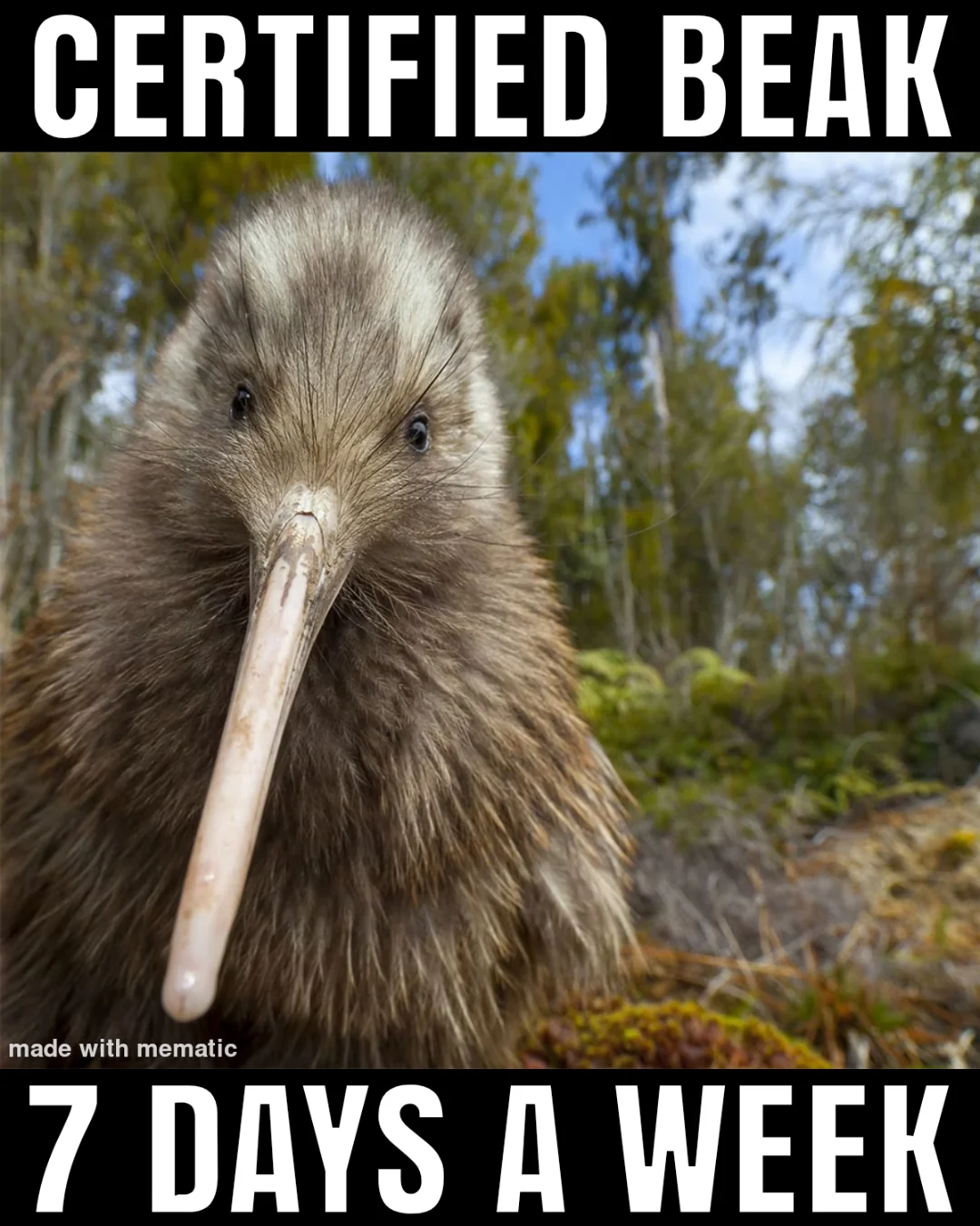
北岛褐几维鸟在喙尖端的鼻孔

哈哈,梗图一张
参考文献:
Amo, L., Galván, I., Tomás, G., & Sanz, J. J. (2008). Predator odour recognition and avoidance in a songbird.Functional Ecology, 22(2), 289–293.
Amo, L., Jansen, J. J., van Dam, N. M., Dicke, M., & Visser, M. E. (2013). Birds exploit herbivore-induced plant volatiles to locate herbivorous prey.Ecology Letters, 16(11), 1348–1355.
Amo, L., Dicke, M., & Visser, M. E. (2016). Are naïve birds attracted to herbivore-induced plant defences?Behaviour, 153(3), 353–366.
Audubon, J. J. (1826). An account of the habits of the Turkey Buzzard (Vultur aura), particularly with the view of exploding the opinion generally entertained of its extraordinary power of smelling.Edinburgh New Philosophical Journal, 2, 172–184.
Bang, B. G., & Cobb, S. (1968). The size of the olfactory bulb in 108 species of birds.The Auk, 85(1), 55–61.
Bonadonna, F., & Nevitt, G. A. (2004). Partner-specific odor recognition in an Antarctic seabird.Science, 306(5697), 835–835.
Caspers, B. A., & Krause, E. T. (2011). Odour-based natal nest recognition in the zebra finch (Taeniopygia guttata), a colony-breeding songbird.Biology Letters, 7(2), 184–186.
Caspers, B. A., Hagelin, J. C., Paul, M., Bock, S., Willeke, S., & Krause, E. T. (2017). Zebra finch chicks recognise parental scent, and retain chemosensory knowledge of their genetic mother, even after egg cross-fostering.Scientific Reports, 7(1), 12859.
Clark, L., & Mason, J. R. (1988). Effect of biologically active plants used as nest material and the derived benefit to starling nestlings.Oecologia, 77(2), 174–180.
Creece, D., Freire, R., & Massaro, M. (2025). Past research and future directions in understanding how birds use their sense of smell.Ibis, 167(4), 853–881.
Cunningham, G. B., Van Buskirk, R. W., Hodges, M. J., Weimerskirch, H., & Nevitt, G. A. (2006). Behavioural responses of blue petrel chicks (Halobaena caerulea) to food-related and novel odours in a simple wind tunnel.Antarctic Science, 18(3), 345–352.
DeBose, J. L., & Nevitt, G. A. (2008). The use of odors at different spatial scales: Comparing birds with fish.Journal of Chemical Ecology, 34(7), 867–881.
Douglas, H. D. (2008). Prenuptial perfume: Alloanointing in the social rituals of the crested auklet (Aethia cristatella) and the transfer of arthropod deterrents.Naturwissenschaften, 95(1), 45–53.
Gagliardo, A., Bried, J., Lambardi, P., Luschi, P., Wikelski, M., & Bonadonna, F. (2013). Oceanic navigation in Cory's shearwaters: Evidence for a crucial role of olfactory cues for homing after displacement.Journal of Experimental Biology, 216(15), 2798–2805.
Gwinner, H., & Berger, S. (2008). Starling males select green nest material by olfaction using experience-independent and experience-dependent cues.Animal Behaviour, 75(3), 971–976.
Hagelin, J. C., Jones, I. L., & Rasmussen, L. E. L. (2003). A tangerine-scented social odour in a monogamous seabird.Proceedings of the Royal Society of London. Series B: Biological Sciences, 270(1522), 1323–1329.
Leclaire, S., Strandh, M., Mardon, J., Westerdahl, H., & Bonadonna, F. (2017). Odour-based discrimination of similarity at the major histocompatibility complex in birds.Proceedings of the Royal Society B: Biological Sciences, 284(1846), 20162466.
Molina-Morales, M., Castro, J., Albaladejo, G., & Parejo, D. (2020). Precise cache detection by olfaction in a scatter-hoarder bird.Animal Behaviour, 167, 185–191.
Nevitt, G. A., Veit, R. R., & Kareiva, P. (1995). Dimethyl sulphide as a foraging cue for Antarctic Procellariiform seabirds.Nature, 376(6542), 680–682.
Nevitt, G. A., Losekoot, M., & Weimerskirch, H. (2008). Evidence for olfactory search in Wandering albatrossDiomedea exulans.Proceedings of the National Academy of Sciences, 105(12), 4576–4581.
Padget, O., Dell'Ariccia, G., Gagliardo, A., González-Solís, J., & Guilford, T. (2017). Anosmia impairs homing orientation but not foraging behaviour in free-ranging shearwaters.Scientific Reports, 7(1), 9668.
Papi, F., Fiore, L., Fiaschi, V., & Benvenuti, S. (1972). Olfaction and homing in pigeons.Monitore Zoologico Italiano - Italian Journal of Zoology, 6(1), 85–95.
Parejo, D., Amo, L., Rodríguez, J., & Avilés, J. M. (2012). Rollers smell the fear of nestlings.Biology Letters, 8(4), 502–504.
Pollonara, E., Luschi, P., Guilford, T., Wikelski, M., Bonadonna, F., & Gagliardo, A. (2015). Olfaction and topography, but not magnetic cues, control navigation in a pelagic seabird: Displacements with shearwaters in the Mediterranean Sea.Scientific Reports, 5, 16486.
Saavedra, I., & Amo, L. (2018). Insectivorous birds eavesdrop on the pheromones of their prey.PLoS ONE, 13(1), e0190415.
Savoca, M. S., Wohlfeil, M. E., Ebeler, S. E., & Nevitt, G. A. (2016). Marine plastic debris emits a keystone infochemical for olfactory foraging seabirds.Science Advances, 2(11), e1600395.
Soler, J. J., Pérez-Contreras, T., De Neve, L., Macías-Sánchez, E., Møller, A. P., & Soler, M. (2014). Recognizing odd smells and ejection of brood parasitic eggs. An experimental test in magpies of a novel defensive trait against brood parasitism.Journal of Evolutionary Biology, 27(7), 1265–1270.
Stager, K. E. (1964). The role of olfaction in food location by the Turkey Vulture (Cathartes aura).Los Angeles County Museum Contributions in Science, 81, 1–63.
Stanbury, M., & Briskie, J. V. (2015). I smell a rat: Can New Zealand birds recognize the odor of an invasive mammalian predator?Current Zoology, 61(1), 34–41.
Steiger, S. S., Fidler, A. E., Valcu, M., & Kempenaers, B. (2008). Avian olfactory receptor gene repertoires: Evidence for a well-developed sense of smell in birds?Proceedings of the Royal Society B: Biological Sciences, 275(1649), 2309–2317.
Wallraff, H. G. (2004). Avian olfactory navigation: Its empirical foundation and conceptual state.Animal Behaviour, 67(2), 189–204.
Wallraff, H. G., & Andreae, M. O. (2000). Spatial gradients in ratios of atmospheric trace gases: A study stimulated by experiments on bird navigation.Tellus B: Chemical and Physical Meteorology, 52(4), 1138–1157.
Wenzel, B. M. (1968). Olfactory prowess of the kiwi.Nature, 220(5172), 1133–1134.
Wikelski, M., Arriero, E., Gagliardo, A., Holland, R. A., Huttunen, M. J., Juvaste, R., & Wistbacka, R. (2015). True navigation in migrating gulls requires intact olfactory nerves.Scientific Reports, 5, 17061.
Wikelski, M., Quetting, M., Cheng, Y., Fiedler, W., Flack, A., Gagliardo, A., & Williams, J. (2021). Smell of green leaf volatiles attracts White storks to freshly cut meadows.Scientific Reports, 11(1), 12912.
Zidar, J., & Løvlie, H. (2012). Scent of the enemy: Behavioural responses to predator faecal odour in the fowl.Animal Behaviour, 84(3), 547–554.
BGM:小红莓乐队 - Animal Instinct

AI 从整集转写里归纳的,不是节目方的宣传语
施泰格用排风扇把气味吹向高空,红头美洲鹫从几公里外逆风精准找到源头,推翻奥杜邦一百三十八年的结论。
信天翁逆风搜索起始点平均位于食物源头下风向二点五公里,最远探测距离突破二十公里。
几维鸟把细长的喙像探针一样插进腐叶土,伴随高频急促的喷气声吸入泥土微孔里的气体找蚯蚓。
AI 读完整集转写后给出的推荐理由
奥杜邦 1826 年缝了一只草包鹿,宣布秃鹫找食靠眼睛,这个结论统治了鸟类学界一百三十八年。直到天然气管道微漏处聚起成群秃鹫,人们才发现它们闻的是乙硫醇——腐肉的味道。这期把两百年误解的推翻过程讲成一条完整证据链:施泰格的排风扇实验、信天翁逆风之字形搜索的 GPS 数据、几维鸟长在喙尖的鼻孔、山雀后天学会的「气味等于肉虫」。
由 AI 从整集转写生成,是创作者说明之外的补充
本期从奥杜邦 1826 年那篇宣称红头美洲鹫靠视觉觅食的论文讲起,梳理人类对鸟类嗅觉长达两百年的误解如何被逐步推翻:天然气管道泄漏处聚集的秃鹫揭示了乙硫醇与腐肉气味的关联,施泰格 1964 年的六十三页著作厘清了奥杜邦的实验误区;随后讲到管鼻类海鸟如何追踪 DMS 气味跨越数千公里觅食,以及塑料释放同类气味导致海鸟误食致死;再介绍北岛褐几维鸟把鼻孔长在喙尖端的独特演化、山雀通过后天学习识别植物求救挥发物、白鹳顺风嗅到十几公里外的割草气味。结尾反思人类用自身迟钝感官武断丈量生物圈知觉边界的认知局限。
点一章从那里开始播 · 与上面创作者标的时间点各自独立
开场:鸟也有鼻子吗
主播借中秋问候切入主题,指出人类对鸟类嗅觉存在长达两百多年的根深蒂固误解,从达尔文时代到二十世纪中叶教科书都写着多数鸟类丧失嗅觉功能,而现代感官生态学已推翻这一结论。
奥杜邦的两套野外实验
1826 年奥杜邦在爱丁堡宣读论文,用草包鹿的视觉欺骗测试和山沟死猪的嗅觉遮蔽测试,宣称红头美洲鹫纯靠视觉觅食。尽管探险学家沃尔顿提出异议,奥杜邦的权威声望仍让鸟类嗅觉退化成为学界共识。
天然气管道泄漏处的秃鹫
二十世纪三十年代末,加利福尼亚联合石油公司在天然气管线中加入恶臭的乙硫醇防泄漏,巡线工人发现微漏处很快聚集红头美洲鹫低飞打转、四处翻腾,成了免费的漏气检测仪。乙硫醇正是动物尸体早期降解释放的核心挥发物。
施泰格厘清一百三十八年的误区
1964 年肯尼斯·施泰格发表六十三页著作,指出奥杜邦的推论建立在食腐鸟毫无鉴别力的错误假设上。红头美洲鹫偏爱死亡一到四天的新鲜尸体,避开含肉毒杆菌外毒素的高度腐败残骸。他用排风扇把气味顺风吹向高空,秃鹫从几公里外逆风精准找到气味源头。
猛禽家族内部的感官分野
新大陆的红头美洲鹫和大黄头美洲鹫高度依赖嗅觉在树林和树冠下搜寻尸体,而同片天空的黑头美洲鹫与旧大陆秃鹫类嗅觉器官发育程度较低,只能靠超长视力或尾随抢食。把视觉与嗅觉结合成复合传感器,是鸟类征服恶劣环境的法宝。
海鸟与 DMS 气味景观
海洋占地球表面百分之七十一,水下鱼群从空中看会被波浪反光遮蔽。内维特教授提出大气气味景观概念:浮游植物被摄食后释放的 DMS 蒸发到海面,形成长达数百公里的气体余留。管鼻类海鸟嗅觉阈值低至皮摩尔每升,连丧失飞行能力的企鹅也能追踪 DMS 潜水围捕磷虾。
信天翁的逆风之字形搜索
内维特团队给漂泊信天翁佩戴 GPS 和胃温记录仪,通过胃部温度骤降测定进食时刻。信天翁巡航时保持与风向垂直的横风滑翔以切割气味线索,闻到气味后九十度大拐弯改为逆风之字形迂回。逆风搜索起始点平均位于食物源头下风向二点五公里,最远探测距离可突破二十公里。
塑料如何成为致命陷阱
海洋塑料微粒表面附着滋生腐生硅藻和微生物菌膜,在阳光与降解作用下同样释放 DMS。远洋海鸟从几十公里外顺味而来,吃下的是坚硬难消化的塑料残片,最终因消化道机械性穿孔或极度饱腹感被活活饿死。
几维鸟把鼻孔长在喙尖
北岛褐几维鸟在无地栖哺乳动物威胁的环境中骨骼中空、双翼退化、视力萎缩,却演化出全球鸟类绝无仅有的外鼻孔形态。伯尼斯·温策尔在二十世纪六七十年代用埋有活体蚯蚓的金属铝盒做实验,几维鸟能精准掠过对照土坑找到地下盲盒。
山雀会读植物的求救信号
雀形目因嗅球小巧长期被归入嗅觉退化行列。植物遭虫害啃食时释放水杨酸甲酯、茉莉酸甲酯等挥发物,大山雀和蓝山雀即使看不到虫和残缺叶片,仍表现出对受害树枝气味的定向飞率。人工孵化、隔绝气味刺激的小鸟则毫无偏好,证明这是后天习得的条件反射。
白鹳顺风嗅到割草味与迁徙导航假说
2021 年马克斯·普朗克团队证实白鹳能借风力在十几公里外嗅到机械割草的气味,把青草味等同于暴露的青蛙、蜗牛和田鼠。1971 年帕比团队提出气味镶嵌地图假说,瓦尔拉夫进一步推出气味梯度双坐标地图假说。
结尾:我们丈量错了什么
主播预告后续将分享凤头海雀、蓝鹱、斑胸草雀等更多鸟类嗅觉故事,并总结人类对鸟类嗅觉近两百年的轻视源于认知狭隘——习惯尊重权威,用自身相对迟钝的感官武断丈量生物圈的知觉边界。
11 月 6 日 · 36 分钟
第120期:我们该如何告别呢?就像当初见面那样 - 期待没有约定的重逢
10 月 30 日 · 1 小时 05 分
第119期:诺奖背后的隐形功臣 - 鸡蛋,银鸥,捣蛋鬼!(下)
10 月 23 日 · 34 分钟
第118期:诺奖背后的隐形功臣 - 麻雀,鸡蛋,芦花鸡!(上)
10 月 16 日 · 31 分钟

鸟瘾综合征 · 9 月 25 日 · 25 分钟
将近两百多年以来,我们一直认为鸟类的嗅觉退化了,只能靠视觉和听觉生活。这些误解可能源自于奥杜邦早年间做的关于红头美洲鹫实验,成为学界共识。上百年以后,有负责天然气巡线的工人发现,管道泄漏散发出来的乙硫醇会吸引秃鹫聚集,才让研究者重新审视鸟类嗅觉。
其实我们一直在用我们和动物相比非常迟钝的感觉去武断判断了动物的感知世界。
北岛褐几维鸟在喙尖端的鼻孔
哈哈,梗图一张
参考文献:
Amo, L., Galván, I., Tomás, G., & Sanz, J. J. (2008). Predator odour recognition and avoidance in a songbird.Functional Ecology, 22(2), 289–293.
Amo, L., Jansen, J. J., van Dam, N. M., Dicke, M., & Visser, M. E. (2013). Birds exploit herbivore-induced plant volatiles to locate herbivorous prey.Ecology Letters, 16(11), 1348–1355.
Amo, L., Dicke, M., & Visser, M. E. (2016). Are naïve birds attracted to herbivore-induced plant defences?Behaviour, 153(3), 353–366.
Audubon, J. J. (1826). An account of the habits of the Turkey Buzzard (Vultur aura), particularly with the view of exploding the opinion generally entertained of its extraordinary power of smelling.Edinburgh New Philosophical Journal, 2, 172–184.
Bang, B. G., & Cobb, S. (1968). The size of the olfactory bulb in 108 species of birds.The Auk, 85(1), 55–61.
Bonadonna, F., & Nevitt, G. A. (2004). Partner-specific odor recognition in an Antarctic seabird.Science, 306(5697), 835–835.
Caspers, B. A., & Krause, E. T. (2011). Odour-based natal nest recognition in the zebra finch (Taeniopygia guttata), a colony-breeding songbird.Biology Letters, 7(2), 184–186.
Caspers, B. A., Hagelin, J. C., Paul, M., Bock, S., Willeke, S., & Krause, E. T. (2017). Zebra finch chicks recognise parental scent, and retain chemosensory knowledge of their genetic mother, even after egg cross-fostering.Scientific Reports, 7(1), 12859.
Clark, L., & Mason, J. R. (1988). Effect of biologically active plants used as nest material and the derived benefit to starling nestlings.Oecologia, 77(2), 174–180.
Creece, D., Freire, R., & Massaro, M. (2025). Past research and future directions in understanding how birds use their sense of smell.Ibis, 167(4), 853–881.
Cunningham, G. B., Van Buskirk, R. W., Hodges, M. J., Weimerskirch, H., & Nevitt, G. A. (2006). Behavioural responses of blue petrel chicks (Halobaena caerulea) to food-related and novel odours in a simple wind tunnel.Antarctic Science, 18(3), 345–352.
DeBose, J. L., & Nevitt, G. A. (2008). The use of odors at different spatial scales: Comparing birds with fish.Journal of Chemical Ecology, 34(7), 867–881.
Douglas, H. D. (2008). Prenuptial perfume: Alloanointing in the social rituals of the crested auklet (Aethia cristatella) and the transfer of arthropod deterrents.Naturwissenschaften, 95(1), 45–53.
Gagliardo, A., Bried, J., Lambardi, P., Luschi, P., Wikelski, M., & Bonadonna, F. (2013). Oceanic navigation in Cory's shearwaters: Evidence for a crucial role of olfactory cues for homing after displacement.Journal of Experimental Biology, 216(15), 2798–2805.
Gwinner, H., & Berger, S. (2008). Starling males select green nest material by olfaction using experience-independent and experience-dependent cues.Animal Behaviour, 75(3), 971–976.
Hagelin, J. C., Jones, I. L., & Rasmussen, L. E. L. (2003). A tangerine-scented social odour in a monogamous seabird.Proceedings of the Royal Society of London. Series B: Biological Sciences, 270(1522), 1323–1329.
Leclaire, S., Strandh, M., Mardon, J., Westerdahl, H., & Bonadonna, F. (2017). Odour-based discrimination of similarity at the major histocompatibility complex in birds.Proceedings of the Royal Society B: Biological Sciences, 284(1846), 20162466.
Molina-Morales, M., Castro, J., Albaladejo, G., & Parejo, D. (2020). Precise cache detection by olfaction in a scatter-hoarder bird.Animal Behaviour, 167, 185–191.
Nevitt, G. A., Veit, R. R., & Kareiva, P. (1995). Dimethyl sulphide as a foraging cue for Antarctic Procellariiform seabirds.Nature, 376(6542), 680–682.
Nevitt, G. A., Losekoot, M., & Weimerskirch, H. (2008). Evidence for olfactory search in Wandering albatrossDiomedea exulans.Proceedings of the National Academy of Sciences, 105(12), 4576–4581.
Padget, O., Dell'Ariccia, G., Gagliardo, A., González-Solís, J., & Guilford, T. (2017). Anosmia impairs homing orientation but not foraging behaviour in free-ranging shearwaters.Scientific Reports, 7(1), 9668.
Papi, F., Fiore, L., Fiaschi, V., & Benvenuti, S. (1972). Olfaction and homing in pigeons.Monitore Zoologico Italiano - Italian Journal of Zoology, 6(1), 85–95.
Parejo, D., Amo, L., Rodríguez, J., & Avilés, J. M. (2012). Rollers smell the fear of nestlings.Biology Letters, 8(4), 502–504.
Pollonara, E., Luschi, P., Guilford, T., Wikelski, M., Bonadonna, F., & Gagliardo, A. (2015). Olfaction and topography, but not magnetic cues, control navigation in a pelagic seabird: Displacements with shearwaters in the Mediterranean Sea.Scientific Reports, 5, 16486.
Saavedra, I., & Amo, L. (2018). Insectivorous birds eavesdrop on the pheromones of their prey.PLoS ONE, 13(1), e0190415.
Savoca, M. S., Wohlfeil, M. E., Ebeler, S. E., & Nevitt, G. A. (2016). Marine plastic debris emits a keystone infochemical for olfactory foraging seabirds.Science Advances, 2(11), e1600395.
Soler, J. J., Pérez-Contreras, T., De Neve, L., Macías-Sánchez, E., Møller, A. P., & Soler, M. (2014). Recognizing odd smells and ejection of brood parasitic eggs. An experimental test in magpies of a novel defensive trait against brood parasitism.Journal of Evolutionary Biology, 27(7), 1265–1270.
Stager, K. E. (1964). The role of olfaction in food location by the Turkey Vulture (Cathartes aura).Los Angeles County Museum Contributions in Science, 81, 1–63.
Stanbury, M., & Briskie, J. V. (2015). I smell a rat: Can New Zealand birds recognize the odor of an invasive mammalian predator?Current Zoology, 61(1), 34–41.
Steiger, S. S., Fidler, A. E., Valcu, M., & Kempenaers, B. (2008). Avian olfactory receptor gene repertoires: Evidence for a well-developed sense of smell in birds?Proceedings of the Royal Society B: Biological Sciences, 275(1649), 2309–2317.
Wallraff, H. G. (2004). Avian olfactory navigation: Its empirical foundation and conceptual state.Animal Behaviour, 67(2), 189–204.
Wallraff, H. G., & Andreae, M. O. (2000). Spatial gradients in ratios of atmospheric trace gases: A study stimulated by experiments on bird navigation.Tellus B: Chemical and Physical Meteorology, 52(4), 1138–1157.
Wenzel, B. M. (1968). Olfactory prowess of the kiwi.Nature, 220(5172), 1133–1134.
Wikelski, M., Arriero, E., Gagliardo, A., Holland, R. A., Huttunen, M. J., Juvaste, R., & Wistbacka, R. (2015). True navigation in migrating gulls requires intact olfactory nerves.Scientific Reports, 5, 17061.
Wikelski, M., Quetting, M., Cheng, Y., Fiedler, W., Flack, A., Gagliardo, A., & Williams, J. (2021). Smell of green leaf volatiles attracts White storks to freshly cut meadows.Scientific Reports, 11(1), 12912.
Zidar, J., & Løvlie, H. (2012). Scent of the enemy: Behavioural responses to predator faecal odour in the fowl.Animal Behaviour, 84(3), 547–554.
BGM:小红莓乐队 - Animal Instinct
AI 从整集转写里归纳的,不是节目方的宣传语
施泰格用排风扇把气味吹向高空,红头美洲鹫从几公里外逆风精准找到源头,推翻奥杜邦一百三十八年的结论。
信天翁逆风搜索起始点平均位于食物源头下风向二点五公里,最远探测距离突破二十公里。
几维鸟把细长的喙像探针一样插进腐叶土,伴随高频急促的喷气声吸入泥土微孔里的气体找蚯蚓。
AI 读完整集转写后给出的推荐理由
奥杜邦 1826 年缝了一只草包鹿,宣布秃鹫找食靠眼睛,这个结论统治了鸟类学界一百三十八年。直到天然气管道微漏处聚起成群秃鹫,人们才发现它们闻的是乙硫醇——腐肉的味道。这期把两百年误解的推翻过程讲成一条完整证据链:施泰格的排风扇实验、信天翁逆风之字形搜索的 GPS 数据、几维鸟长在喙尖的鼻孔、山雀后天学会的「气味等于肉虫」。
由 AI 从整集转写生成,是创作者说明之外的补充
本期从奥杜邦 1826 年那篇宣称红头美洲鹫靠视觉觅食的论文讲起,梳理人类对鸟类嗅觉长达两百年的误解如何被逐步推翻:天然气管道泄漏处聚集的秃鹫揭示了乙硫醇与腐肉气味的关联,施泰格 1964 年的六十三页著作厘清了奥杜邦的实验误区;随后讲到管鼻类海鸟如何追踪 DMS 气味跨越数千公里觅食,以及塑料释放同类气味导致海鸟误食致死;再介绍北岛褐几维鸟把鼻孔长在喙尖端的独特演化、山雀通过后天学习识别植物求救挥发物、白鹳顺风嗅到十几公里外的割草气味。结尾反思人类用自身迟钝感官武断丈量生物圈知觉边界的认知局限。
点一章从那里开始播 · 与创作者标的时间点各自独立
开场:鸟也有鼻子吗
奥杜邦的两套野外实验
天然气管道泄漏处的秃鹫
施泰格厘清一百三十八年的误区
猛禽家族内部的感官分野
海鸟与 DMS 气味景观
信天翁的逆风之字形搜索
塑料如何成为致命陷阱
几维鸟把鼻孔长在喙尖
山雀会读植物的求救信号
白鹳顺风嗅到割草味与迁徙导航假说
结尾:我们丈量错了什么
节目里自然聊到的,不是广告

AI 对内容的推测
☕🧄 这个比喻出自 2009 年周立波的一句「喝咖啡的怎么能和吃大蒜的呆在一起呢」;郭德纲后来在《你要高雅》里回了一句「雅和俗分不开,喝着咖啡就着大蒜,秋水共长天一色」。我们借它标注风格取向 —— 两端没有高下,编辑部式与熟人局式都能做出极好的节目。
https://www.ximalaya.com/album/82617014.xml复制概要、章节、提及与推广标注由 AI 生成,可能有误;内容版权归创作者,声湃按创作者开放的 RSS 收录。了解收录与 RSS →

11 月 6 日 · 36 分钟
第120期:我们该如何告别呢?就像当初见面那样 - 期待没有约定的重逢
10 月 30 日 · 1 小时 05 分
第119期:诺奖背后的隐形功臣 - 鸡蛋,银鸥,捣蛋鬼!(下)
10 月 23 日 · 34 分钟